
Introduction
By the early 20th century, private railway companies began to integrate railway development with urban development. Today, over 60% of Tokyo‘s population relies on public transportation, and Japan boasts numerous excellent practices of Transit-Oriented Development (TOD).
Established in 1955, the Urban Renaissance Agency (UR) has focused on wide range of housing developments and urban redevelopment. We actively pursue TOD projects, having completed over 200 initiatives, in collaboration with local governments and private entities.
Globally, TOD is increasingly recognized, especially in Asia, where population growth leads to various urban issues. Efforts to reduce carbon emissions is vital, driving interest in TOD.
This website aims to share our TOD experience and know-how, and we are glad if it would help your efforts for enhancing TOD in your countries.
TOD History
n the early 1990’s, Peter Calthorpe (Architect, Urban Planner) advocated the concept of TOD which encourages the development of full and vibrant communities designed to be centered on transit facilities. Specifically, the concept encouraged organizing growth to be compact and transit-supportive, mixing a variety of commercial and residential real estate within walking distance of a transit stop, and promoting open space and a sense of community.
Starting in the Kansai region, located in the western part of Japan’s Honshu Island and known as a major economic hub, Hankyu Railway – one of the largest private railway companies in Kansai region – introduced the concept of Transit-Oriented Development (TOD) in Osaka in 1910. This approach involved developing land around terminal stations with a blend of commercial and office spaces. Additionally, Hankyu Railway developing residential area (new towns) in the suburban areas. In 1920s, Tokyu Railway, another largest private railway company initiated TOD concept in Tokyo. Both companies continue to lead many TOD projects across Japan.
Perspective for TOD
1. Four types of TOD
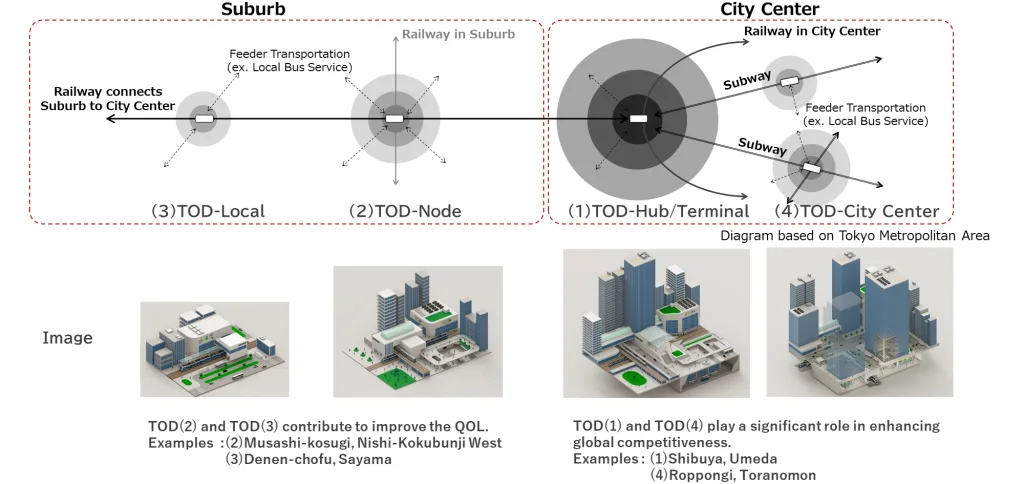
From our wide range of TOD experience, we define TOD as urban development that features public transportation and integrated development around station.
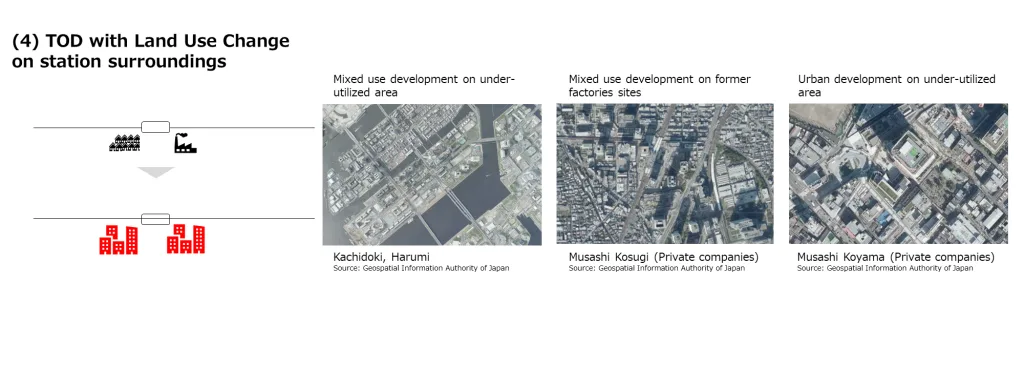
Our perspective and images of each TOD((1)~(4)) are shown below.
2. Four opportunities to realize TOD
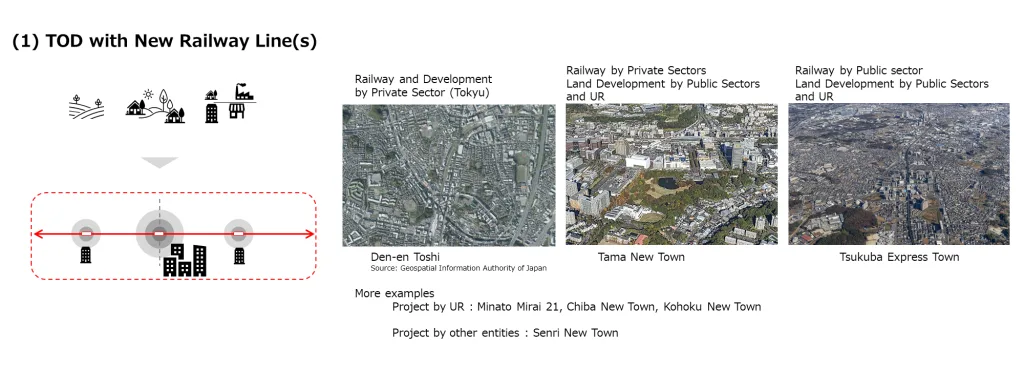
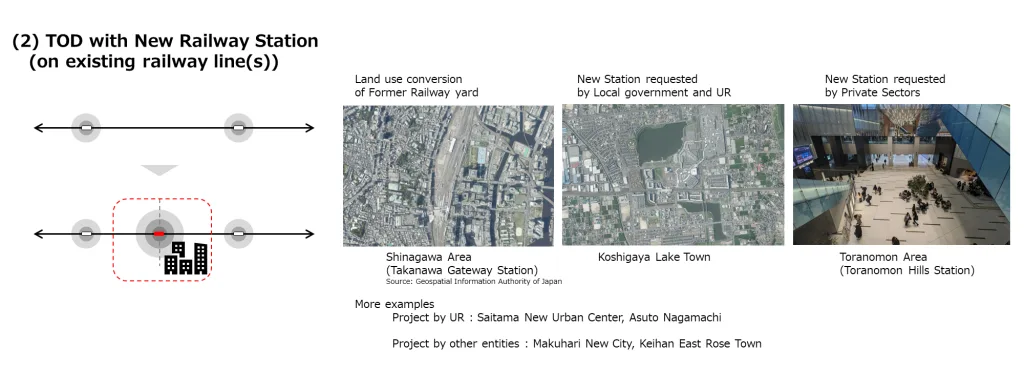
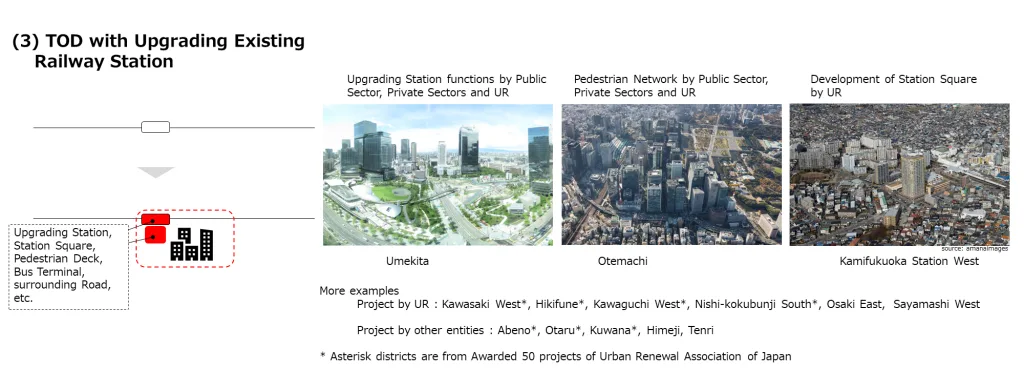
Based on our long experience, there are 4 opportunities to realize TOD.
3. Infrastructures and Functions for better TOD
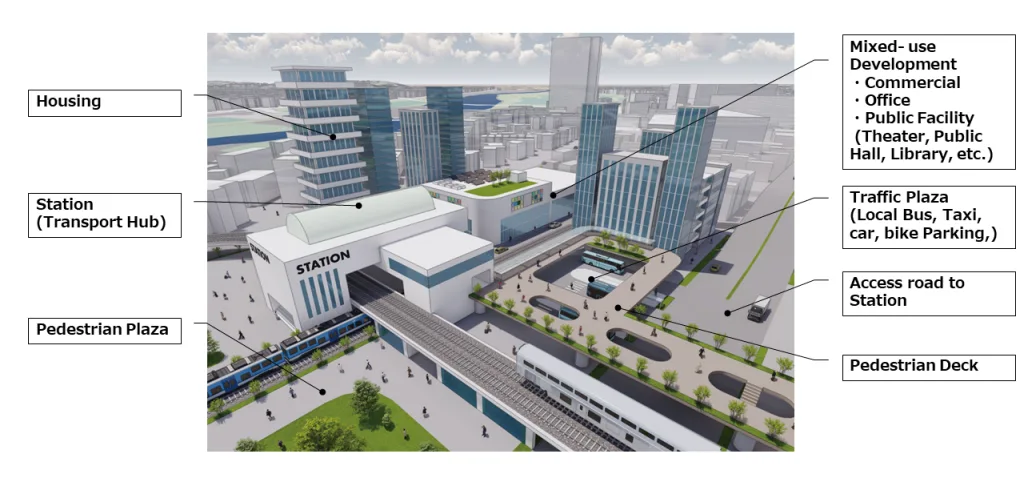
TOD consists of several infrastructures and functions bellow. Among them, keys for better TOD are Traffic Plaza for feeder transit(local bus), Pedestrian Plaza, and Mixed-use Development including housing.
In Japan, effective methods such as land readjustment and redevelopment have been conducted to locate such plazas and functions around stations.
4. Proper Coordination
For successful TOD, the proper coordination between various stakeholder is essential.
UR has taken such role in many projects all over Japan.
要发表评论,您必须先登录。